


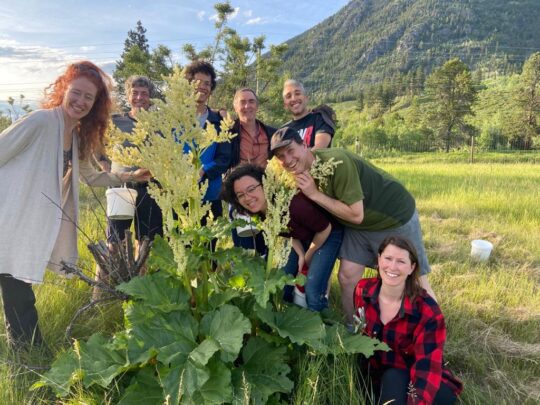
From the beginning, the center has operated largely as a gift economy. Much of what you see today; the buildings, furnishings, equipment, gardens, and infrastructure has been made possible through countless acts of generosity. Chairs, tables, tools, vehicles, building materials, professional expertise, and financial contributions have all been offered by people who believed in the vision of creating a place dedicated to awakening.
Clear Sky has no paid staff.
The people who live here are long-term Dharma practitioners who have chosen a path of service known as Karma Yoga. Karma Yoga is a traditional path of awakening through selfless service. Residents dedicate their lives to supporting the center, the teachings, and the wellbeing of others while simultaneously using work itself as a vehicle for mindfulness, compassion, wisdom, and transformation.
Karma Yoga is not volunteerism in the conventional sense. It is a rigorous spiritual path.
Practitioners train to bring attention, care, and excellence to every task, whether teaching meditation, cleaning a bathroom, preparing food, managing finances, gardening, maintaining buildings, or supporting guests. The aspiration is to leave no trace of self-centeredness behind and instead cultivate increasing awareness, service, and presence.
This commitment to practice and service allows Clear Sky to operate with remarkably low overhead while directing resources toward the continuation of the teachings and the wellbeing of the wider spiritual community.
When Clear Sky was founded, many of us were deeply devoted practitioners. Our teachers and the teaching were our anchors. We purchased the property so that people could engage in serious retreat practice and long-term spiritual training.
Many residents hold jobs and contribute what they could. Yet beneath the surface, many of us carried the belief that money and spirituality belonged in separate worlds.
We feared that focusing on money might somehow contaminate or diminish our commitment to loving-kindness, compassion, generosity, and awakening.
The result was that we often avoided having the right financial conversations. We would have meetings that would go on for hours and would skirt around the issues.
Eventually, we completed our first comprehensive budget and discovered a difficult truth: we were operating at a loss.
That moment became an important turning point.
Through a grant from the Enterprising nonprofits in British Columbia, we were able to work with financial consultant Michele Cherot, who later joined our Board of Directors. Michele patiently helped us understand our financial reality and taught us how to read the story hidden within the numbers.
For many of us, this was the first time we truly understood how finances function within an organization.
But numbers alone were not enough.
We also needed to understand our emotional and psychological relationship with money.
This led us to bring in Deborah Price from the Money Coaching Institute. Through her work, we were introduced to money archetypes and began exploring the unconscious beliefs, fears, and patterns influencing our decisions.
As a community, we discovered that we scored highly in archetypes such as the Innocent and the Martyr.

We realized that we had unconsciously delegated responsibility for revenue generation to our teachers and fundraising lead. Many of us wanted the benefits of a thriving center without fully engaging with the realities required to sustain it.
As our awareness grew, something important changed.
We began to understand that money is not only about numbers.
Money touches our deepest relationships with survival, safety, belonging, power, trust, contribution, and responsibility.
Financial conversations became shorter, clearer, and more productive.
Rather than endless meetings that circled around the same issues, we developed a shared language that helped us identify what was really happening beneath the discussion.
We became more capable of naming fears, assumptions, motivations, and patterns.
We suffered less because we were seeing more clearly.
Gradually, our culture shifted.
Instead of asking only:
“Can we spend this money?”
we also began asking:
“If we spend this, how will it be replenished?”
Our focus expanded beyond reducing expenses to include generating healthy, sustainable revenue.
Our fundraising capacity strengthened.
Our decision-making improved.
We became more strategic.
Most importantly, we became more mature in our relationship with money.
Today, major initiatives are often assessed using a set of guiding questions:
• Is it aligned with our vision and purpose?
• Do we have the time, energy, and resources?
• Is there a functional revenue model?
• Will it generate sustainable abundance?
• Do we have the necessary skills and capacities?
• Is this the right time?
• Will it energize us or deplete us?
• How does it support Clear Sky’s overall wellbeing and strategy?
• Who else needs to be involved?
As our financial maturity grew, something unexpected happened.
Our trust grew.
Our intimacy grew.
Our ability to work together grew.
We discovered that money was not separate from spiritual practice.
Money became another arena in which awareness, compassion, honesty, wisdom, and collective responsibility could develop.

The lessons we learned as a community eventually inspired Karen McAllister, our funding director, to develop the Money & Spirituality program.
Karen has been working with individuals around money patterns, financial wellbeing, and spiritual practice since 2008. In 2021, she created the Money & Spirituality course to help spiritual practitioners bridge the gap between their inner and outer lives.
The program explores:
• Personal money stories and conditioning
• The psychology of scarcity and abundance
• Money archetypes and unconscious patterns
• Receiving, generosity, and stewardship
• Survival, belonging, power, and purpose
• Aligning financial choices with values and awakening
Participants can begin with the four-week online Money & Spirituality course and continue into the six-month small-group coaching program for deeper integration and practice.
These programs emerged directly from the lessons Clear Sky learned through its own journey of bringing Dharma and finances into a healthier relationship.
We believe that awakening includes every aspect of life including our relationship with money.